About
One founder, one farm, a long career in the field.
Possible Agriculture is Luca Brew's biological farming consultancy and biochar production operation. Based in Central Victoria. Working with farmers, councils, turf managers and feedlot operators across Australia.
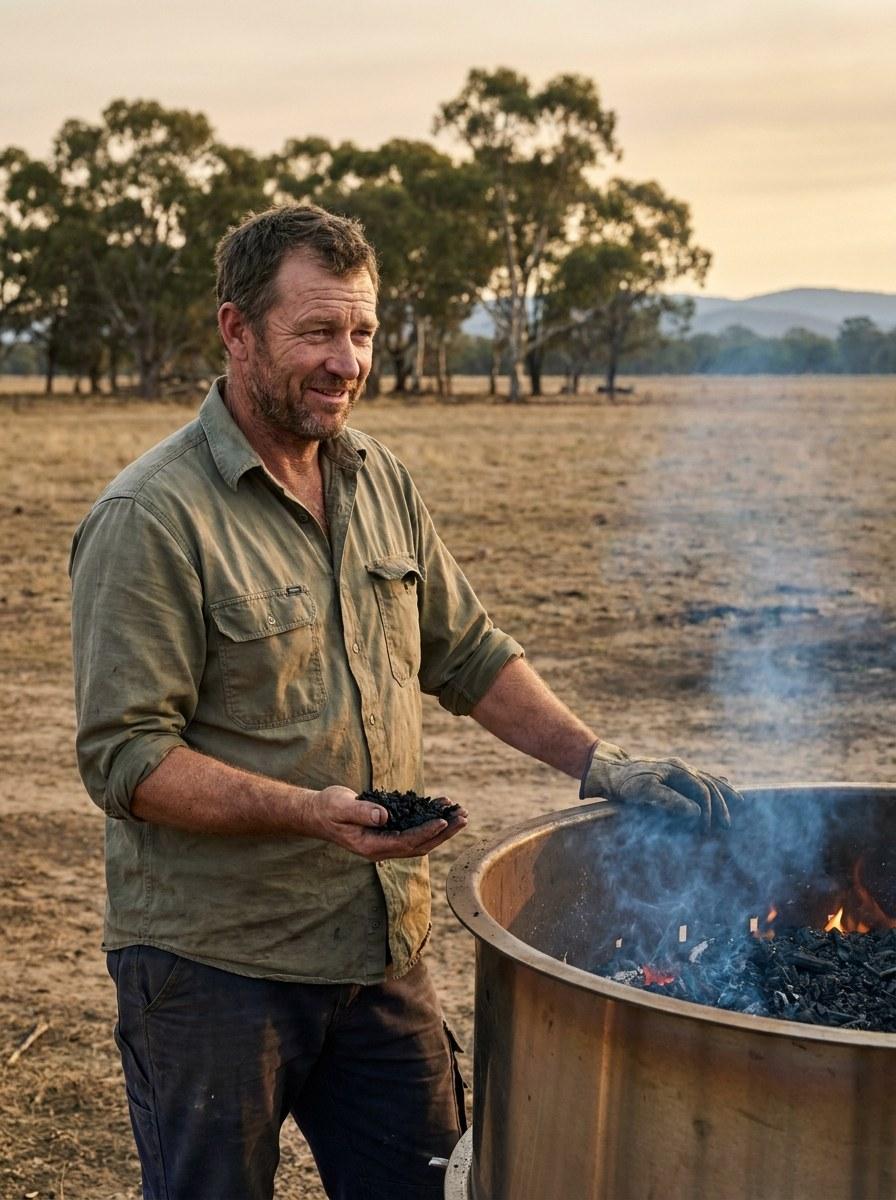
The founder
From Luca.
I've been working in biological farming, agronomy, environmental remediation and biochar production for years now. The work started on my own land in Central Victoria — making char from storm-ravaged trees and shelterbelt residues that would otherwise have been fire hazards — and it expanded into consulting because the same questions kept coming up across other people's properties.
A big chunk of what I do now is expert consultations on biochar. After enough time in the field, I've seen what works on a putting green, what works in a feedlot ration, what works in a parkland subsoil, and where biochar's not the right answer. The published research has caught up to a lot of what we already knew from running the kiln; the gap is in translating that research into something a farmer or council manager can actually act on. That translation is the work.
The other side of the practice is silvaculture and forest management — converting fire-load and storm debris into a productive soil-carbon resource rather than a hazard. The flame-curtain method we use is a controlled industrial process: pyrolysis temperatures held to spec, output carbon content independently lab-tested, particle size graded for the intended use. A long way from an open-paddock burn.
Three ways we work: we'll come to your property and produce biochar on site, we'll supply biochar by the cubic metre, or we'll take on consulting and project work — biological farming, forest management, carbon, water. If you've got a paddock, a putting green, a parkland, or a milking shed where biochar might fit, call me.
— Luca Brew. Possible Agriculture, Central Victoria.
What we do
Two halves of one operation.
The product
Possible Agriculture Biochar — Australian Sugargum hardwood, fired at high pyrolysis temperatures, quenched with rainwater. Independently lab-tested at 88.6% total carbon. Sold by the cubic metre, delivered loose or on pallets.
See the product page →The consulting
Biological farming system design, forest and biomass management, carbon-farming scoping, water-treatment projects. Working alongside whatever agronomist or stock manager you already have.
See the services page →Field expertise
The areas Luca consults across.
Biochar production
Flame-curtain method on-farm. Sustainable Sugargum hardwood feedstock. Pyrolysis temperature control, rainwater activation, particle-size grading. NATA-tested 88.6% total carbon output.
Agronomy & biological farming
Qualified agronomist. Full scope of agronomic practice — soil testing, nutrient programs, paddock and pasture system design — with a biology-first orientation by preference.
Silvaculture & forest management
Reforestation, shelterbelt design, woodlot management, and converting fire-load and storm debris into biochar on-site via the flame-curtain method. Turning a liability into a soil-carbon resource.
Environmental remediation
PFAS stabilisation (Sørmo et al. 2021 inclusion rates), heavy-metal immobilisation, stormwater filter media design, contaminated-site pilot-trial scoping. Where the high-temperature activated biochar profile earns its credentials.
Livestock & dairy nutrition
Feed-additive integration at 0.6–1% dietary DM. Mycotoxin binding, methane reduction, dairy yield trial design. Working with vets and feed-mill operators on safe inclusion protocols.
Carbon farming & ACCUs
Honest scoping of carbon-credit eligibility under the Emissions Reduction Fund. Methodology matching, baseline measurement design, working alongside ACCU specialists on the formal submission.
If you're considering a brief — turn, paddock, golf course, council parkland, contaminated site, or livestock operation — start with a phone call. We'll work out together whether biochar (or biology, or silvaculture) is the right tool for what you're trying to solve.
Provenance
An old principle, an industrial process.
Storm-ravaged trees and fallen limbs from farms across central Victoria — wood that would otherwise be fire hazards — are carefully slow-cooked in low-oxygen conditions, then quenched with rainwater. The principle of putting charred biomass into soil is old (Amazonian terra preta is the most famous historical example), but the process here is industrial: controlled pyrolysis, measured carbon content, graded particle size, NATA-accredited lab certification on every batch.