Service · Silvaculture · Forest management
Silvaculture, forest and biomass management.
Reforestation, shelterbelts, fire-load reduction, and converting woody waste into biochar on-site via the flame-curtain method. Controlled pyrolysis temperatures, measured carbon output, graded particle size. A liability on the paddock becomes a soil-carbon resource.
The work
Three angles, one practice.
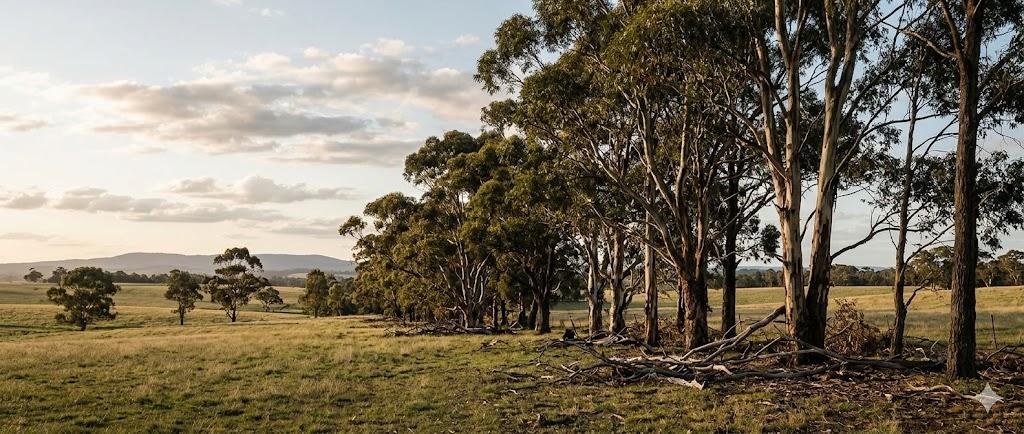
Forest management on an Australian rural property usually means three things at once. First, reforestation and shelterbelts — designing tree systems that produce shade, biomass, wind protection, and water-cycle benefits. Second, fire-load reduction — clearing accumulated storm debris and dropped limbs from existing woodlots. Third, biomass conversion — turning that woody material into biochar on-site rather than burning it, chipping it, or letting it sit as fuel.
We do all three. We can run a flame-curtain biochar production day on your property — converting your own woody waste into a soil-carbon resource you can use or sell — and we can advise on long-term shelterbelt design that produces ongoing biomass for future production days.
Historical context
An old idea, executed with modern combustion control.
Charred biomass as a soil amendment has a long history. The best-known example is the Amazonian terra preta soils — pre-Columbian carbon-enriched dark earths that retain their fertility centuries after the practice ended. Closer to home, Australian cultural burning produced measurable soil-carbon enrichment under repeated cool-fire regimes (Davis et al., 2024).
Our flame-curtain method is a different process. Pyrolysis temperatures are controlled, the carbon content of the output is independently lab-tested, particle-size is graded for the intended use, and emissions are substantially lower than open-fire alternatives. The result is a measured, repeatable product — closer in character to industrial activated carbon than to a paddock burn.
The principle is old; the execution is industrial.
Frequently asked questions
What kinds of properties is this for?
Rural properties with woodlots, shelterbelts, paddock trees, or post-storm debris streams. From hobby farms with a single shelterbelt to large grazing properties with 100+ hectares of woody cover. The common factor is biomass on the ground or standing that could be doing more work for the operation.
What does "fire-load reduction" actually mean in practice?
Storm-ravaged trees and fallen limbs from across Victoria's Western District accumulate as fire hazards if left in place. Our work converts that biomass into biochar via the flame-curtain method — which is a controlled, low-emission pyrolysis process. The fire load goes down, the soil-carbon stockpile goes up.
Can you produce biochar on my land?
Yes — and it's usually the most cost-effective option if you have the woody-waste stream for it. The flame-curtain method requires open ground, a water source, and the wood. We bring the kiln, the process, and the safety setup. Output stays on your property, ready to use as a soil amendment or to sell.